Showing posts with label community solar garden. Show all posts

Monday, October 13, 2014

A Family's Journey to the Sun: Part Two

It is National Energy Awareness Month and we're celebrating by continuing our story about a family who is reducing their energy use.

In Part One of this story, we found out about the energy Will Finn and Sandra Beirne are saving at their home through an energy assessment and upgrades. Just around the time of this HomeRx Assessment, Solarize La Plata was accepting participants. Finn and Beirne signed up to take part.

As part of the process, Shaw Solar came to their home and did a site assessment. The outcome was not what they'd hoped for.

Shaw solar's utility bill analysis surmised that they would need a 6 kilowatt (kW) system to power their family's needs. The roof is marginal because they are shaded by a hillside and many trees. The house is oriented on north-south axis with the roof facing east and west. Because of these issues, Shaw recommended a pole mount system, which would have shaded their family garden and created what some might consider an eyesore in their neighborhood.

Though this was a setback for the family, sunnier news came quickly in the form of a Community Solar Garden. 
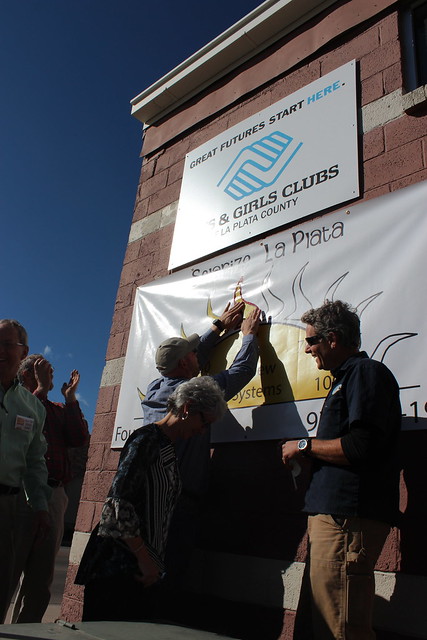
John Shaw & Friends
 at the Girls and Boys Club
At about the time they found out that the roof-mounted system would be out of reach, La Plata Electric Association approved Policy 366, which made it possible for the creation of Community Solar Gardens. Shaw Solar had two gardens to choose from- one in Ignacio and one in Durango. 

Because the Durango array will be located on the Boys and Girls Club of La Plata County building, Finn opted for this closer array so that his son could see where their power was being produced. Since the array will be visible from Main Avenue and  it is located on a non-profit that works with kids, there is a good chance that his son and other kids will be learning about the benefits of solar in their community- which were positives for Sandra and Will.

Using a 5% increase in electricity costs, Shaw estimated their payback to be approximately twelve years. Finn's family feels good knowing that electric prices will likely be rising faster than that (potentially producing a faster payback) and the environmental choice to take part in this Community Solar Garden was clear for them. They are now signed up to subscribe for 6 kW of power from this garden and feel much relieved that this was an option since their own roof mounted array was not.   

So they've got a safe and efficient home. They are on their way to solar power. What more can they do and what is next?

Find out the surprising answer in the third and final part of this series by subscribing to the 4CORE newsletter.

About the Family
Will Finn is an internal medicine physician and his wife Sandra Beirne is a pediatrician. They have a four-year-old son Jasper. Previous to moving to Durango, Dr. Finn spent four years practicing broad-spectrum Internal Medicine on the Navajo Reservation in Shiprock. He and his wife enjoy hiking, biking, kayaking, and skiing. He believes that if everyone could make their home more energy efficient, we would make our community stronger and our world more liveable.

Tuesday, July 24, 2012

State of Solar Energy in Southwest Colorado


Today is an exciting time for renewable energy worldwide and here in southwest Colorado. This newsletter will be one in a series that discusses what is happening in solar energy and how it affects us here in southwest Colorado.

Recently an industry trade group was formed. We call ourselves Southwest Solar Installers Association or SSIA. This group was formed by local solar installers with the goals of education and promotion of renewable energies, primarily focused on solar, in the four corners area.


Education

The educational aspects focus on teaching the public what solar can do for us, and where it is best used. Demonstrations at local events and locations, such as the Durango Discovery Museum, give kids and adults alike the chance to play with solar toys and electronics to better understand their uses and limitations. Please come to play, experiment, and ask lots of questions. Who knows, you may come up with some great ideas for how we can better use solar energy to help our planet.


The second aspect of our educational side is to work with and teach our policy makers how we can best use solar to meet our sustainability and economic goals. Collaborating with the Durango City Council, 4CORE, and La Plata Electric Association (LPEA), we are working to show the value our industry has for our local economy. In the past 2 years the solar industry has generated over $5 million dollars for our region, with almost 300 net metered customers in LPEA territory alone producing over 100 Megawatt Hours (MWH) annually.

Solar installations have economic impacts beyond just our companies and employees. Solar companies hire electricians, engineers, excavators, and roofers, to name a few. We buy lots of supplies locally, from wire and conduit to pipes and concrete. Most of the money from a solar installation is kept within the local economy, creating jobs and demand for goods and services.

A third component of SSIA education focuses on the continuing education of all installers. Whether that means more certifications, such as North American Board of Certified Energy Practitioners (NABCEP), or safety requirements from Occupational Safety and Health Administration (OSHA), we strive to be better at what we do. Best installation practices are a key component to keeping a good name for our industry and we regularly share tips that may make things safer, more efficient, or more cost effective.


Promotion of Renewable Energy

The policy side of our group follows up with the education we try to share with policy makers. SSIA is focusing on how we can deploy more solar energy, in the most cost effective manner, to our regional grid. The companies within our group primarily install net metered photo voltaic (PV) systems for residential and small commercial applications. This means that the power produced is used at the same location where it is produced and excess electricity flows back onto the electric grid. We believe that this point of use production and consumption is one of the most effective uses of solar energy.

However, not everyone has the ability to install panels at their location. One possible solution is to install “community solar gardens.” This means a much larger solar array is tied into the grid in a suitable location so customers can buy the panels and the energy they produce. We are working to develop a policy with LPEA that meets their standards for what is often referred to as “virtual net metering”, meaning the production is at a different site than the usage meter of an LPEA member. Currently our member owned co-op does not have a policy that would allow for this, but we are confident that working together we can find a solution.

Another policy we would like to see implemented is the use of our local green energy funds to deploy more renewables. Currently, members of LPEA have been buying green energy blocks. This money can be used to buy more wind power from places like Wyoming, or can stay in a local renewable energy fund. This fund is has typically been used to install educational solar PV systems at our local schools. This is a great way to educate kids and teachers on the benefits of solar energy.

Another possible use of funds could be to augment the current renewable energy credit (REC) payments from Tri-State and boost local installation of more residential and commercial PV. This could help make southwest Colorado a leader in renewable energy while creating jobs and boosting the local economy. This policy would not cost the regular LPEA member anything as the funds are revolving and come from members that already buy “Green Blocks” for their homes or business.

These two policies would come at net zero cost to members or citizens and could easily double the amount of solar energy on our local grid within two years. SSIA is working on these and other issues to help deploy more renewable energy locally. After all, we have one of the best regions in the country for harvesting the power of the sun. Contact SSIA for more info.

Please voice your opinions regarding renewable energy, virtual net metering, and green energy funds to your local utility, as well as local, state and federal government representatives. The more our community gets involved in renewable energy the more independent and resilient our community will become.

Stay tuned to future Energy to Evolve Blogs and 4CORE newsletters for solar information about technology, costs and innovations, including how to use solar thermal systems for hot water and space heating. If you have any questions about solar please contact an SSIA member.

See you out in the sunshine!


About the Author

Derek has over 12 years of experience in the solar industry, beginning with a BS degree from St. Lawrence University in Environmental Science Philosophy. Working as a solar installer his senior year of school, he was able to install PV systems in cloudy upstate New York. After making his way to Durango, Derek continued his solar education and experience which led to the birth of SolarWorks in 2006.

Now, Derek has a beautiful wife Ginny and son Granite, and enjoys all that Colorado has to offer. He continues to learn and seek higher certifications, sitting for the NABCEP solar exams later this year. Derek is proud to serve the community and the environment, and wakes up with a smile every morning because the sun shines so much in Durango.